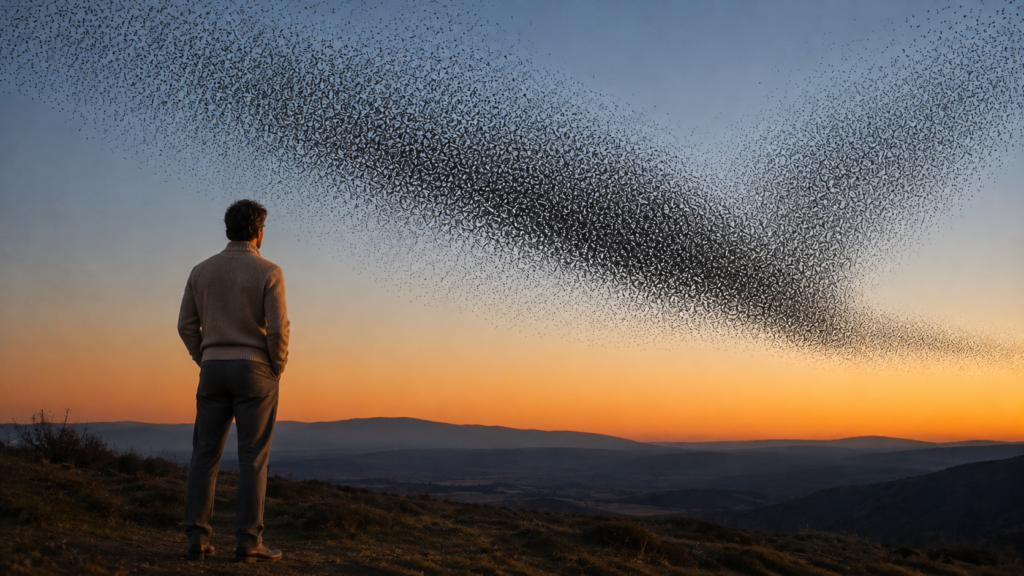
The image that best captures a Sageocratic society is neither the machine nor the pyramid, but the living organism. In a body, each organ has its function, none acts for itself alone, and none truly commands the others. Yet everything holds together and constantly adjusts. What if a society could work in this way?
A body where no one commands
In a body, the heart does not do the work of the liver, nor the liver that of the brain. Each organ has its function, but none acts for itself alone: it depends on the overall balance as much as it contributes to it. The brain coordinates, it does not command. Information circulates ceaselessly, and when an imbalance appears somewhere, the whole body adjusts, without a chief having to decide everything. Not by magic, but because the parts are connected. An organ that grows at the expense of the others has a name: a tumour.
Drawing on the living, without copying it
Sageocracy does not claim that a society is a biological organism. It simply observes what the living has developed over billions of years: balance through relations, adaptation through the circulation of information, resilience through diversity, stability through movement. So many qualities that no pyramid of command has ever managed to produce, and that a society could nonetheless recover at its own scale.
Crises as signals rather than enemies
A society conceived in this way stops seeing crises as enemies to defeat. A crisis says something, like a pain or a breakdown. The usual reflex is to silence the signal; the logic of the living is to listen to it in order to understand what must change. This is a complete reversal of our relation to disorder. What this intelligence gives concretely, at the scale of a city or a country, the forthcoming book will unfold; this article merely sets out the image.