

The Book
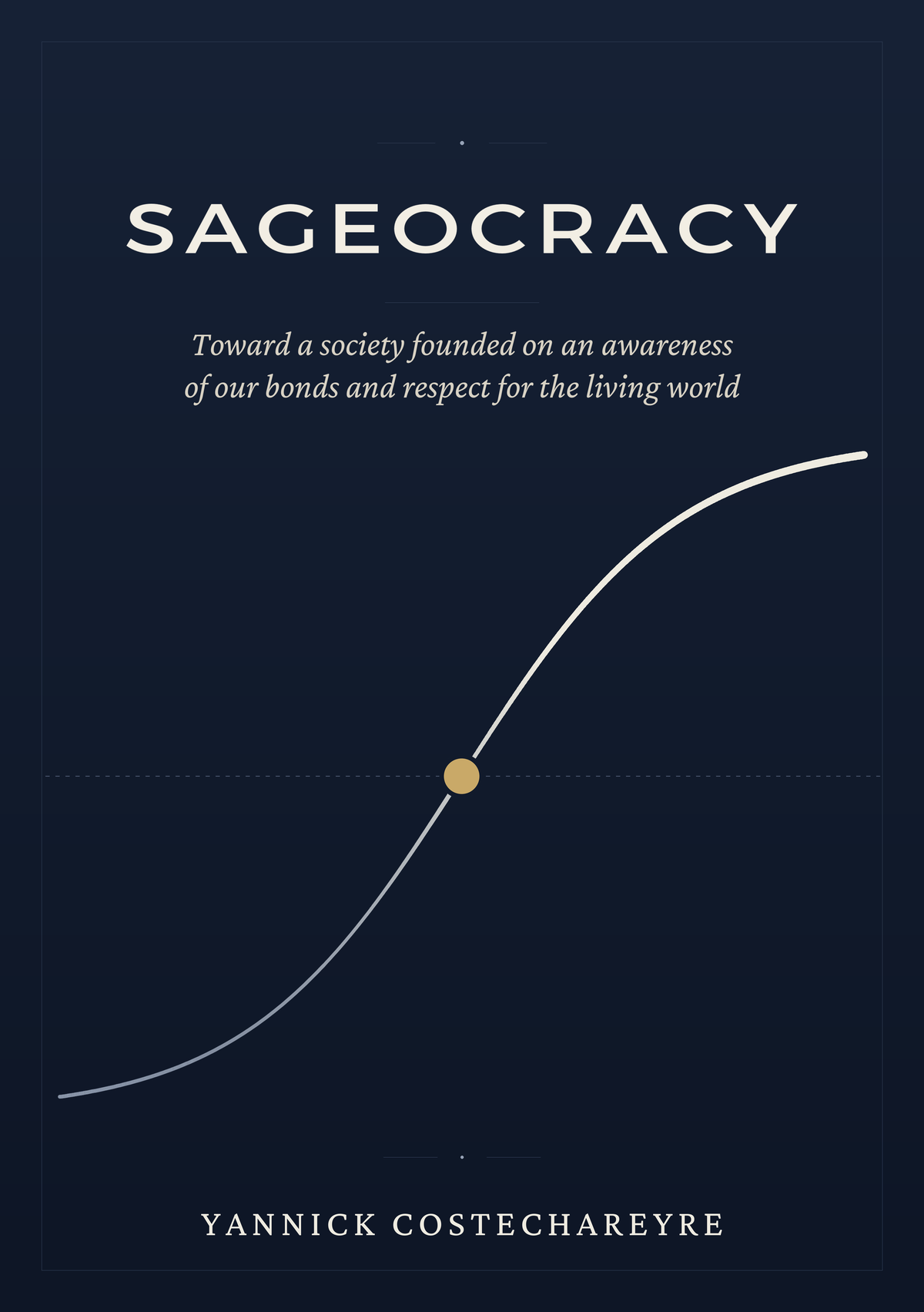
Sageocracy, toward a society founded on an awareness of our bonds and respect for the living world
A book. A vision. A possible, concrete path to get there.
A concrete path for the crossing
For a long time, the transformation of society was thought of in two ways. On one side, reforms within the existing frameworks. On the other, visions of another civilization, with no precise path to get there.
Between the two, a space remained largely unexplored: that of the transition itself.
How do we move, concretely, from a system founded on money and accumulation to a system that recognizes real contributions to the living world? How do we do it without breaking what still holds together the daily life of millions of people?
The book Sageocracy proposes a possible, concrete path for this crossing. An architecture that brings together economic transformation, a changing relationship to property, the security of essential needs, and the maintenance of collective stability during the crossing.
Author: Yannick Costechareyre
Essay, 346 pages, 27 chapters in six parts
Two appendices: the Living Constitution of Sageocracy and the Oath of Reliance
Publication: September 16, 2027
Price in France: 25 € (including VAT), printed on demand
The Living Constitution, in Appendix 1, may be freely reproduced and translated, provided its source is given: it can also be read on this site.

A word from an author who was not meant to write it
This book should not have existed. It was written by a man who had no calling to write, a man whose path led from civil engineering to architecture, then from real estate to accompanying people, who became an author almost in spite of himself.
The idea was born in 2004. Not a book, a site, a platform: what would make Sageocracy possible. The will was there. The means were not. It took more than twenty years to find them. In June 2025, with the help of artificial intelligence, he was finally able to build the site on his own, and the book imposed itself. Almost in spite of its author. It took nearly a year and a half of work.
What this book carries today is not one more theory. It is what resists simplification. It is what, after forty years of watching how we build the places we live in, and years of exploring consciousness, asks to be named.
Twenty-two years of ripening
Throughout those twenty-two years, Sageocracy remained within him, waiting. He went through a major international real estate portal project, which was meant to fund Sageocracy and never saw the light of day, despite more than ten years of effort. Then a time of letting it lie dormant, accepting the idea that he might never make it happen. A deep exploration of consciousness. With each trial, something was ripening.
The site came before the book
Work on sageocracy.org began in June 2025. The book, for its part, was not planned: it imposed itself as the site took shape. This chronology is not an anomaly: it reveals the very nature of the project. The tipping point does not begin with the publication of a book. It begins with each person who recognizes that the current framework is no longer enough.
A proposal, not a program
What we do not see governs what we see.
“This book is neither a manifesto nor a program: it is a proposal. The direction it opens up isn't something I really invented. I discovered it gradually, by observing the world, life in all its forms, and human beings.” Yannick Costechareyre, introduction to the book
Sageocracy is neither a utopia, nor a recipe, nor a manifesto. It is a proposal, to gradually reorient the way we decide, work, own, pass on, and live together. Everything it proposes can be discussed, challenged, and improved.
A society where the essentials are guaranteed to everyone, and produced by all, each in their own measure. Where decisions start from the situation rather than from power, and where what each person brings is finally seen. Where land and homes are no longer investments, but places entrusted to those who live in them and take care of them.
The book unfolds in six parts. It starts from what many people feel (the signal), proposes another way of deciding, moves across the areas of life (money, learning, health, work, housing, science, artificial intelligence), then through what runs through a life, from birth to death. It then describes the passage, from the people's choice to the crossing, and finally a society that has made the passage: justice and mediation, the planetary commons, and a day in Sageocracy.
At the heart of the book, an economic keystone: the essentials are a common good, unconditionally; everything else is paid for, during the crossing, in transition currency; Reliances, for their part, open up responsibilities. Getting there takes no revolution: a choice made by the people, by referendum, with at least two-thirds of the votes cast and a minimum turnout, then a long crossing in which no one loses the roof over their head.
The book doesn't stop at principles. In Chapters 19 to 22, it describes a possible, concrete path for moving from one world to the other, and it says what that path costs. Readers in a hurry can start with “What Changes for You,” in Chapter 22.
Not in one great night of revolution, but over a great many small mornings.
In the lineage of those who have named
This book stands in the lineage of the thinkers who have, each in their own way, named a part of what is being sought today.
From philosophers of complexity to anthropologists of debt, from theorists of post-growth economics to explorers of consciousness, from ecologists of regeneration to pioneers of collective decision-making: so many contributions that resonate in these pages, without any of them being fully reflected there.
The book presents itself as a proposal that has ancestors, from Gandhi to Ivan Illich, from André Gorz to Elinor Ostrom, and that tries to hold together what they each thought through separately.
Publication in September 2027
The book will be published on September 16, 2027. A first version, very different, had been offered to publishers; none took it up. Publishing today is asking itself questions about books written with the help of artificial intelligence, and this one was: the author explains how in Chapter 15. The English edition, Sageocracy, has already been translated; other languages will follow. Price in France: 25 € (including VAT). Printed on demand.
Time for a careful edition
The text is complete. Between now and the day the book reaches the bookshops, in September 2027, several months remain. This delay is not idle waiting: it is the time of the work that makes a book.
Work on the text
Editorial review, copy-editing, checking of quotations and references, typesetting, layout, cover, then proofs read and corrected before printing. Each stage takes several weeks, and none can be rushed.
The press and booksellers
Journalists discover a book several months before it comes out. The press office needs this time to present the work to newsrooms, radio and television, and booksellers need it to read the book before recommending it to their readers.
Why September
In France, the autumn season that opens in September is one of the great moments of the publishing year. Spring 2027 will be taken up by the French presidential election, which will concentrate media attention. A book about the way we decide together deserves to be read for its own sake, not as one more voice in a campaign.
What you will read as you close the book
A traveler arrives in a place where no one pays anymore.
At the workshop where they mend the strap of her bag, she reaches for her wallet without thinking. The craftsman smiles. It will take her several days to break the habit. This place does not exist yet. The book calls it Sageocracy and tells how it could come to be: a society that rests not on a few sages, but on the clear-sightedness of all.
What if the essentials were guaranteed to everyone, and produced by all? What if land and homes stopped being investments and were entrusted to those who live in them? What if, in a disagreement, we no longer asked “Who is right?” but “What does this situation really call for?”
Getting there takes no revolution: a choice made by the people, with at least a two-thirds majority, then a long crossing in which no one loses the roof over their head, and rents come to an end. The book is frank about what everyone gains, and what some will lose.
Before going to sleep, the traveler writes to her sister: “They know sorrow and grief, just like us. But I haven't seen anyone afraid of tomorrow.” Then she adds: “I'm staying a little longer.”
The author, in a few lines
Yannick Costechareyre, born in 1964, spent forty years in civil engineering, architecture and real estate before realizing that the problem did not lie in the buildings. He has been working on this project since 2004.
To go further
The book will be published on September 16, 2027. The English edition, Sageocracy, has already been translated; other languages will follow.
What each of us can do right now is at the end of Chapter 19. The book shows what is possible. The site will show how many of us want it.
To be informed of the publication, to join the momentum of the project, or to support Sageocracy International, you can sign up right now. Everyone who signs up will automatically receive a notification as soon as the book is published and with each new translation.