
What if the dysfunction were not an accident?
Our crises keep returning, whatever the leaders. What if they were not failures of the system, but precisely what it produces?
Analyses, perspectives and founding texts of Sageocracy.
Our crises keep returning, whatever the leaders. What if they were not failures of the system, but precisely what it produces?
Nothing exists in isolation, so nothing can be decided in isolation. The first principle of Sageocracy is not a feeling, but a demand for lucidity.
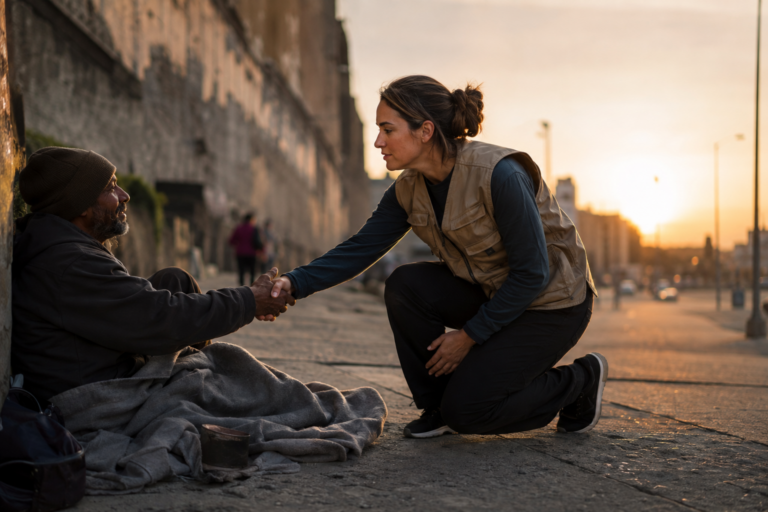
The work of NGOs and Sageocracy do not stand in opposition: one repairs the damage of the present system, the other transforms the logic that produces it at the source. A difference of plan, not of merit.
Each of our choices has effects we do not see: on others, elsewhere, later. Widened responsibility means deciding while taking those effects into account: not out of morality, but out of lucidity.
No human organisation is right once and for all. A wise society does not seek the perfect system: it gives itself the means to correct itself ceaselessly, as reality changes.
The word misleads: in Sageocracy there is no council of sages deciding for everyone else. Wisdom is not a status reserved for a few, but a lucidity that society makes possible for each person.
In Sageocracy, a decision is not entrusted to a centre that commands, but placed where the situation is truly understood. Neither numbers nor distant expertise: lucidity, as close as possible to what is real.
Eating, having a home, being cared for, learning: in a sageocratic society, these needs no longer depend on what one can pay. The essentials are guaranteed to everyone, without condition.
Sageocracy does not ask us to invent an unprecedented model, but to extend to the common good a logic already proven in business.
Among those who take the first step, women are a large majority. It is neither coincidence nor a minor detail.
We have long known that these heat waves will return. So why are we never prepared?
We have learned to judge a decision by its source: was it adopted by the majority? was it made by the competent authority? These questions are useful, but they miss the essential point. A decision is not sound because it gathered the most votes, nor…
Sageocracy is not only a civic project: it is a direction for life. This article explores what that means concretely: starting with oneself, practicing coherence daily, and making the alignment between values and actions the foundation of a lasting commitment.
Sageocracy rests on a hypothesis that may seem bold: that human beings are capable of functioning collectively from values deeper than competition and short-termism. This hypothesis is not an ideological conviction: it is, increasingly, a scientific observation.
There is something particular about being among the first. Not a privilege: a responsibility. This article gives voice to the first Sageocrats: those who chose to register before the movement was visible, before the map appeared, before the book was published.
Talking about money in a project that criticizes the excesses of a civilization built on accumulation demands a particular kind of honesty. Sageocracy needs financial support to exist, and its very principles compel it to name that clearly.
Behind every project that intends to change something in the world, there is a structure. The Sageocracy International association is the project’s institutional envelope: deliberately lean, governed according to the principles it defends, and in service of dissemination rather than its own complexity.
By registering as a Sageocrat, what exactly am I committing to? The answer deserves to be stated with precision: registering is a civic act, not a spiritual step or a partisan commitment. It is formally signaling a direction, nothing more, and nothing less.
A book on world governance released in seventeen languages before it is even published: this choice is not trivial. The multilingual dimension of Sageocracy is not an accessory of the project: it is one of its conditions of validity.
Every society rests on a convention: what counts. What is recognized is valued. The Reliances propose to make visible what GDP does not see: care, transmission, ecological resilience, contribution to the fabric of the living.
Representative, national democracy, founded on periodic suffrage, has reached the limits of what it can produce in the world we live in. This is not an indictment: it is a diagnosis. And the question now is to understand what might come to complement it.
Sageocracy designates a system of governance founded on wisdom as the central criterion of legitimacy: not heredity, wealth, or election alone. A sober definition, six foundational principles, and what this word actually names.
Each article published here is a particular light on the project. To grasp the whole, the manuscript is the central reference. To join it, registration is free and open.