

A child reads that bees are vanishing by the billion. He has understood the information, but not its meaning, nor what is at stake behind it. In an ordinary classroom he would get a framed answer, write three lines in his notebook, and the class would move on. The information would have been transmitted, and yet nothing would have happened. Sageocracy starts from this simple observation: receiving content is not learning.
The hidden assumption of school
School as we know it rests on an idea rarely named: that a child is a receptacle to be filled, and that learning consists of receiving, memorising and then giving back. This assumption is not absurd; it even made it possible to teach billions of people to read in a few generations, a precious gain that is not to be undone. But it froze, and it ended up masking what it did not see: a human being does not learn like a hard drive being filled. He learns through relationships, through experience, and through what has meaning for him. Teachers know this, often better than anyone; the problem is not their commitment, but a structure that confused teaching with transmitting content.
To learn is to encounter
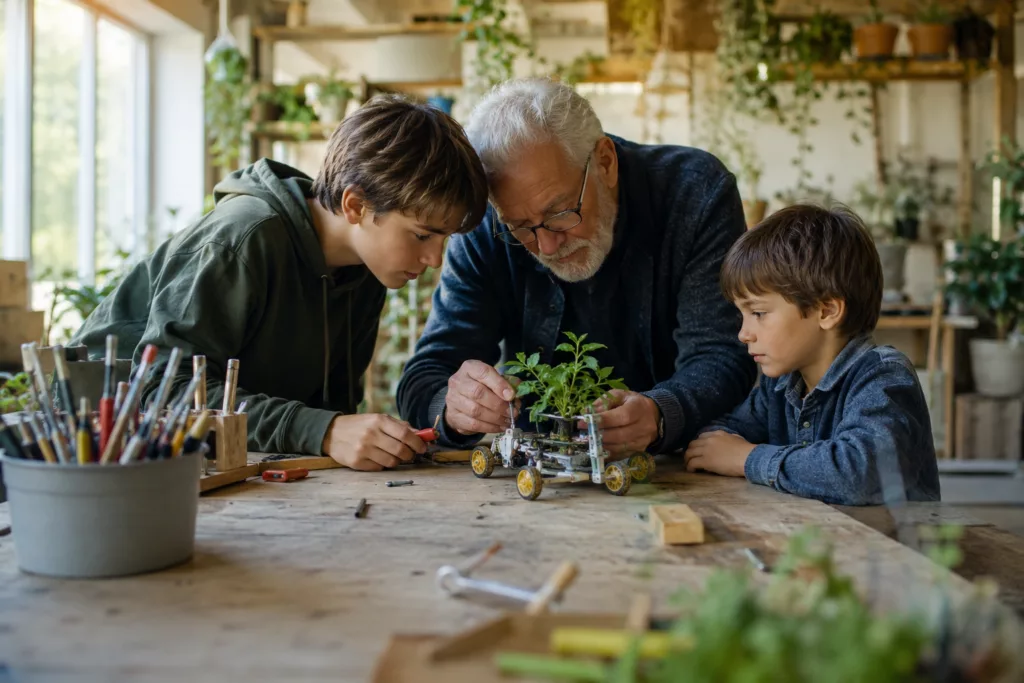
In a sageocratic logic, learning begins with a question that belongs to the one who learns, alive because it has a reason to exist for him at this moment of his life. From it, everything shifts. The adult is no longer merely the one who knows: he becomes the one who accompanies, who senses what is missing to cross the next step, and who makes it available at the right moment. The ages mix, for a younger one sometimes grasps what an older one no longer sees. Error ceases to be a fault and becomes again what it is: precious information, a necessary point of passage. Contents do not vanish for all that: grammar, mathematics, history, the sciences remain. But they cease to be an end in themselves and become tools serving an understanding built in contact with the real.
What forms beyond knowledge
A child who grows up this way does not only learn to read and count. He develops capacities our systems measure poorly: perceiving the dynamics of a collective, seeking to contribute rather than to perform, entering into relationship with the living instead of treating it as scenery. These capacities are not an add-on; they form beings able to find their way in the real. How a community concretely organises this transmission, how it welcomes children who arrive wounded, and what place it invents for learning at every age, the forthcoming book will unfold; this article only lays down the principle.