A book on global governance written in French, translated into seventeen languages even before its editorial publication, distributed through a site designed to be read on every continent: this choice is no accident. It reflects a fundamental conviction of the project: that the challenges our societies face cannot be solved at the national scale, and that answers emerging from a single culture, a single language, a single tradition of thought will necessarily be incomplete.
This article explains why the multilingual and global dimension of Sageocracy is not an accessory to the project: it is one of its conditions of validity.
The problem of the universal from a single place
All the great modern political proposals have claimed universality from a particular place. Liberal democracy was largely conceived in English, out of the British and American philosophical traditions. Marxism was formulated in German, out of a European reading of history. Human rights were proclaimed in French, out of a revolution that had its own colonial contradictions.
These partial universalisms produced important ideas, real institutions, undeniable advances. They also produced considerable blind spots: realities their original languages and cultures were unable to see, populations whose experiences found no translation within those conceptual frameworks.
Sageocracy does not claim to escape this problem. It was born of a singular line of thought, carried by a French-speaking author, nourished by particular philosophical and spiritual traditions. But it takes this problem seriously from the outset, building its multilingual distribution not as a surface translation, but as an invitation to mutual enrichment.
What each language brings
Translating Sageocracy into seventeen languages is not a translation exercise in the literal sense. It is an exercise in transposition, in verifying that the project’s core concepts have resonances, equivalents, and nuances of their own in each language and each culture.
The concept of syntony, for example, resonates differently in Japanese, where notions such as ma (the right space between things) or musubi (the harmonious bond) offer ways in that French does not allow. The concept of the living finds deep echoes in African philosophical traditions, notably ubuntu (I am because we are), which enrich its meaning far beyond what the European philosophical tradition can articulate. The notion of living contribution engages naturally with community practices rooted in many cultures of the Global South, where the value of an act is not measured by its market profitability but by its effect on the community.
These resonances are not coincidences. They suggest that Sageocracy, far from being an export of a Western worldview, touches on something more fundamental: intuitions about just governance that many human traditions have developed independently, and that the project seeks to articulate in a language accessible to the twenty-first century.
Why now
The question of timing is no less important than that of language.
We are living through a rare convergence of conditions that makes this moment particularly favorable to the emergence of a proposal like Sageocracy.
The first condition is the simultaneous crisis of confidence in political systems on every continent. This crisis is not uniform: it takes different forms in Europe, in Latin America, in Africa, in Asia. But it shares a common trait: a growing number of citizens, in very different cultural contexts, feel that existing institutions are no longer capable of meeting the real challenges of their time. This feeling creates an opening (not a guarantee, but an opening) for alternative proposals.
The second condition is global connectivity. For the first time in history, an idea can spread simultaneously across dozens of countries, in dozens of languages, without passing through the filters of national publishing houses, dominant media, or political machinery. This connectivity has well-documented perverse effects: disinformation travels as fast as truth, often faster. But it also creates a capacity for the diffusion of serious ideas that did not exist thirty years ago.
The third condition is the acceleration of global crises. Climate disruption, mass migration, pandemics, geopolitical instability: these phenomena place growing pressure on national political systems, and make it increasingly obvious that national responses to global crises are structurally insufficient. This obviousness opens a space for governance proposals that think at the scale where problems actually arise.
What the World Map means
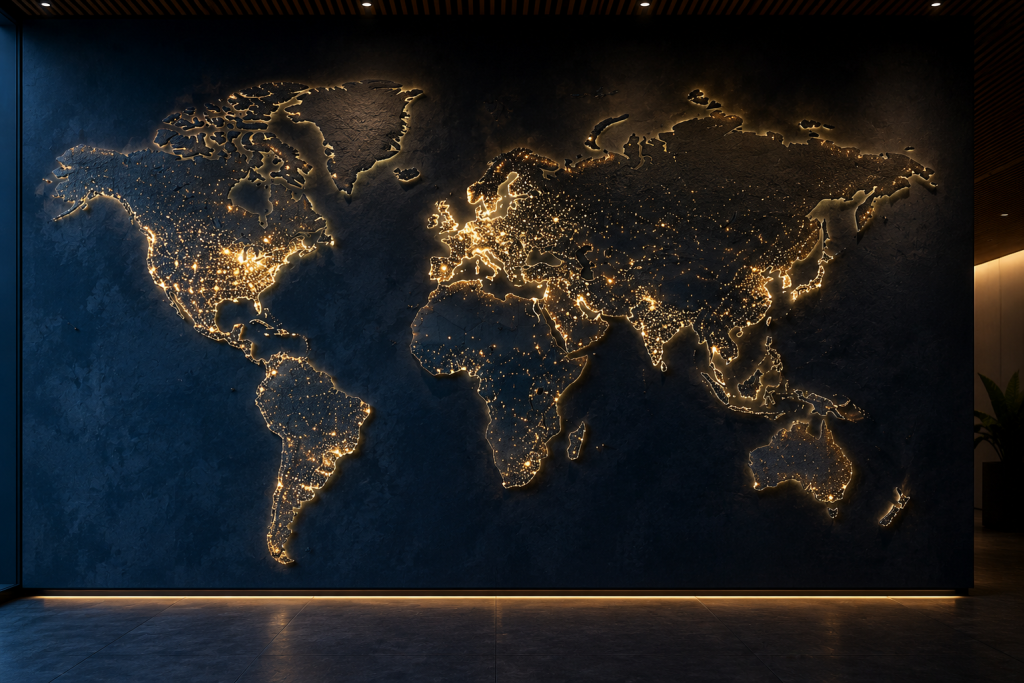
The World Map of Sageocrats, the global mapping of registrations by country, is at once a practical tool and a political symbol. It is not yet visible: this is a deliberate choice, which is itself a demonstration of coherence. The counts by country will be made public only when they reach a threshold of international relevance. Figures have meaning only when they reflect a real dynamic at the scale where it counts.
What happens in the meantime is real, even if it is invisible. Every registration is recorded the moment it is submitted, dated, geolocated, validated. It appears in the global register and will count when the time comes.
When that threshold is reached, the map will come alive. Each point that appears will be an act of civic sovereignty: a person, somewhere in the world, who will have decided that this direction suited them and chosen to signify it. The progression will be visible country by country, making it possible to track the dynamics of diffusion, to identify the regions where the project takes root, to measure what opinion polls do not measure: a will formally expressed, dated, irreversible.
The 17 languages as a commitment
The seventeen languages in which Sageocracy is distributed are not an exhaustive list of the world. They are a starting point: a commitment the project makes to the diversity of traditions of thought and human experiences that can enrich, correct, and deepen what a single author, from a single place, can only sketch.
Sageocracy will fully be what it wants to be only once it has been read, criticized, translated, and transformed by people whose experiences are radically different from those that gave rise to it. This is a condition of its validity, not a risk to its coherence.
A project of global governance that can speak only to those who already resemble it is not a project of global governance. It is a club.
« An idea that can be expressed only in one language remains the prisoner of one culture. Sageocracy wants to belong to them all. »
The book La Sageocratie: Vers une société fondée sur la conscience, la syntonie et le vivant is available in seventeen languages on sageocracy.org. It is currently undergoing editorial submission and will soon appear in print.