

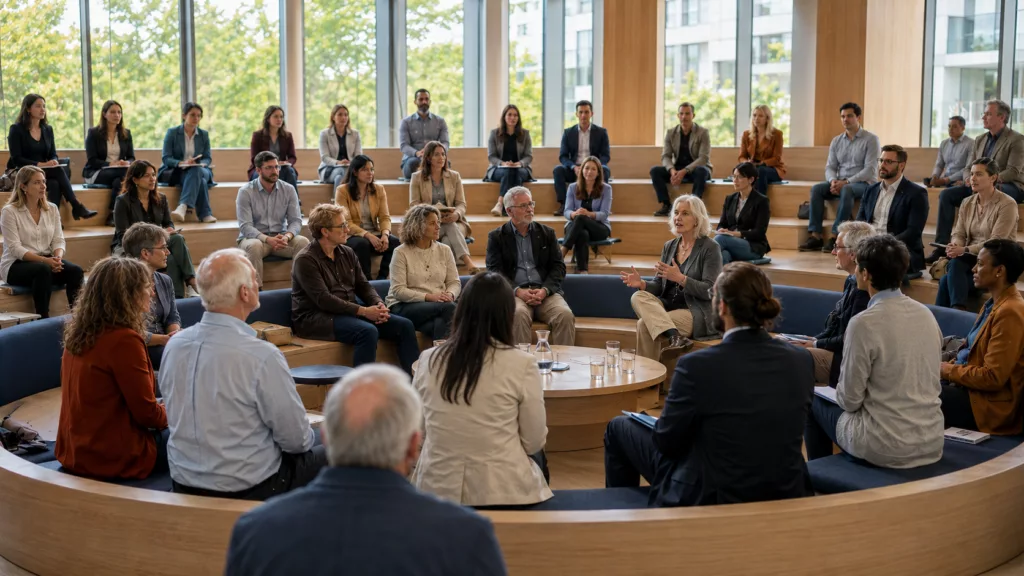
We have learned to judge a decision by its source: was it adopted by the majority? was it made by the competent authority? These questions are useful, but they miss the essential point. A decision is not sound because it gathered the most votes, nor because it came from on high. It is sound when it has genuinely taken into account what was at stake. This is the shift that Sageocracy proposes: to ground legitimacy no longer in numbers alone, but also in the quality of understanding.
What we are talking about
Sageocracy, literally « government by wisdom », does not mean by this any moral superiority or title. Wisdom here is defined simply: the capacity to see what is connected. Organizing collective life on the basis of this awareness of connections, of the broadened responsibility that follows from it, and of respect for the balances that make life possible: that is the proposal. Not a closed system, but a direction.
Not merely an « improved » democracy
The distinction matters. Democracy grounds legitimacy in numbers; Sageocracy grounds it in understanding. The two can coexist, and it is in fact through existing democratic channels that such an orientation might one day be recognized. But the principle is different.
Is it realistic? Some experiments offer a glimpse
Several initiatives, already carried out in robust democracies, give a sense of it. In Ireland, on issues deemed too sensitive by the political class, assemblies of citizens chosen by lot (briefed by experts, exposed to opposing views) produced clear recommendations, which were then adopted by referendum. In France, the Citizens’ Convention on Climate brought together, in 2019 and 2020, one hundred and fifty citizens chosen by lot to formulate proposals. What is at work there is not the vote, but deliberation: taking the time to understand before deciding. At the scale of a city, participatory budgets, from Porto Alegre to Paris, show the same thing: when they are informed and given responsibility, residents make their choices seriously.
What this brings into view
These initiatives are not « Sageocracy. » But they show one thing: when the conditions for shared understanding are brought together, fairer decisions emerge; not through a compromise wrested from the parties, but because the initial positions adjust as the situation comes into clearer view. The book calls this syntony: that moment when elements that seemed to be in opposition cease to be so, because they are finally perceived as parts of one and the same whole.
Sageocracy does not ask human beings to change their nature. It proposes to change the framework: to decide on the basis of the situation rather than from a position. It is not a utopia to be reached, but a possibility to be recognized, and, as these experiments suggest, there is nothing unrealistic about it.