

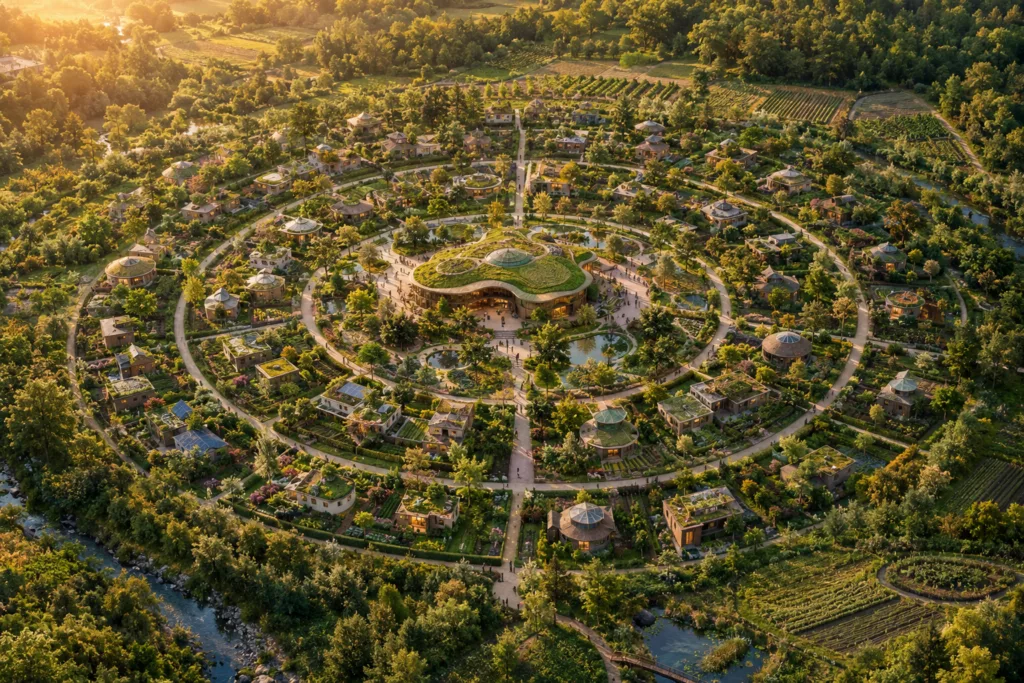
The metropolis is not a natural evolution of humanity. It is a recent construction, born of a precise logic: concentrating resources, power and opportunities in a few points. Many have not really chosen the megacity: people end up there because that is where the jobs are, where one studies, for want of anything better. Others have chosen it, and find a precious freedom there. But as a whole, this way of dwelling is not the fruit of a collective desire, and it is not made for us.
The big city as a symptom
Over hundreds of thousands of years, the human being took shape in collectives where everyone knew everyone, where the effects of one’s acts were visible, where a direct relationship with nature remained possible. It is there that his rhythm, his psychology, his capacity to perceive interdependence were formed. Anonymity, extreme density and uprooting from nature are not progress: they are conditions that weigh on health, and that many compensate for as best they can. This does not mean that anyone will be driven out of big cities: no one will be driven out of them, nor go without the essentials there. It means that they are a symptom, not the model of the future one sometimes imagines.
Knowing one another, a matter of scale
In a sageocratic organisation, the territory is structured otherwise: no longer as big cities that absorb and concentrate, but as networks of human-scale communities, linked to one another. Each is autonomous enough for its essential needs, and linked enough to the others to benefit from their contributions. Size is not fixed by an abstract principle, but by a concrete question: how far can we really know one another, perceive each person’s contributions, feel the effects of our acts on the whole? Beyond that, anonymity sets in, and with it the drifts it allows. Some anthropological research places this scale at around a few hundred to a few thousand people; beyond, communities of communities are better than a single indistinct entity.
Neither strangers, nor decided from afar
In this logic there are no strangers in the collective, only people one does not yet know. Children grow up knowing the farmers who produce their food, the artisans who built their houses, the elders who carry the memory of the place. Decisions about space are made in circles where each one can speak, be heard, understand what is being decided. Nothing is planned from afar by an authority that does not see the territory: everything emerges from those who inhabit it. How these networks connect, how one dwells there and passes places on, and how one moves from today’s model to this one, the forthcoming book will unfold; this article only opens the door to it.